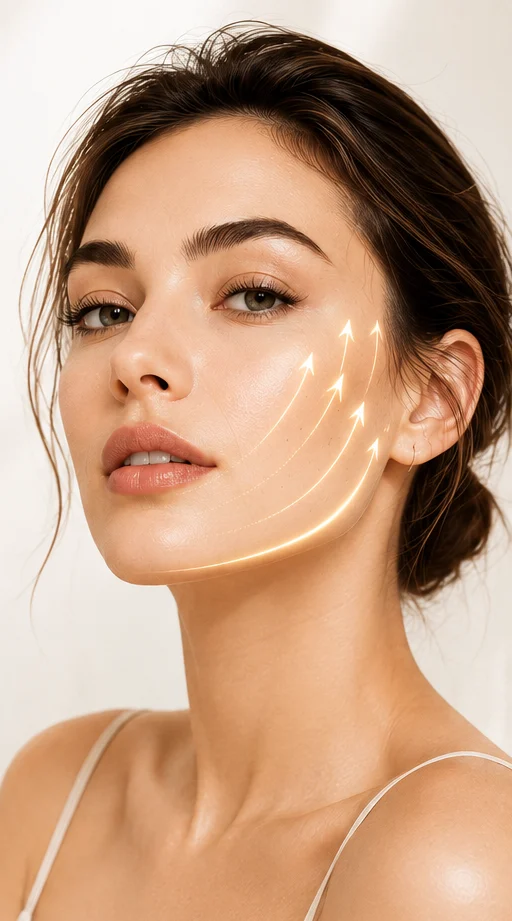

When the area beneath your eyes looks hollow
A hollow beneath the eye often first catches your attention under a ceiling light. A curved shadow appears near the inner corner and becomes less obvious when you face a window. That change with lighting is a clue to the role of contour. It cannot tell you on its own whether treatment would help. The first decision is to work out what you actually see: a groove, a patch of colour, a bag with a shadow underneath, or a mixture of these features.
The boundary between the eyelid and cheek
The tear trough is a groove near the inner part of the lower eyelid where the lid meets the cheek. The skin is thin, and small differences in the position of the cheek or the fullness of the eyelid affect how light falls across it. Some people have a visible groove from a young age and can recognise it in family photographs. For others, a change in the support or fullness of the cheek makes the same groove more noticeable over the years.
Colour behaves differently from a shadow. Brown pigment can remain visible in soft, even light. Thin skin can also allow underlying vessels to show through, giving the area a bluish appearance. A raised lower-lid bag can create a dark line along its lower edge even when the tissue beneath the line has adequate volume. Filling the shadow in that situation may make the whole region puffier. A clinician looks at the lower lid and upper cheek together, with your face relaxed and then in motion.
What changes the first appointment
Note whether the appearance stays similar throughout the day or varies with puffiness, itching, watering or rubbing. Bring a photograph taken on a typical morning if the area looks different by the time of an afternoon appointment. Mention allergies, dry eyes, contact lenses, previous eye or facial surgery and any previous fillers. A product placed years ago may still matter when investigating a swollen or uneven area. If you have records, bring the product name, the date and the part of the face treated.
A longstanding groove that looks similar on both sides can usually be discussed at an elective visit. New swelling on one side, persistent irritation, or a new change in eyelid position deserves a medical or eye-care assessment first. Painful swelling around an eye with fever, pain on moving the eye, double vision or reduced vision needs urgent medical attention. Sudden loss of vision is an emergency. Do not wait for a cosmetic consultation to assess these symptoms, even if you also have familiar shadows beneath your eyes.
Options when the main feature is a groove
For a carefully selected patient, a clinician may discuss a hyaluronic acid product in the dermal filler family. The aim is to soften a visible step between the lid and cheek. The clinician may judge the cheek, the trough, or neither to be a suitable treatment area. Ask what change they expect in ordinary daylight and what they expect will remain when the room is lit from above. A reasonable outcome can include a visible groove as well as your natural eyelid contours.
The lower lid has little room to conceal an irregularity. Persistent swelling, lumps, asymmetry and a blue-grey hue can follow filler. Pre-existing bags, frequent fluid retention or previous lower-lid surgery can shift the balance away from injection. The precise product and intended use matter. In Canada, ask whether the proposed product is licensed for the planned area, who will perform the treatment and what experience they have managing complications near the eye. Being able to dissolve some hyaluronic acid products does not make the procedure fully reversible.

When the concern is skin quality or a lower-lid bag
Platelet-rich plasma uses a preparation made from a patient's own blood. Some studies have explored it for changes in the quality or colour of the skin around the eyes. The studies use different preparations and outcome measures, which limits how confidently an improvement can be predicted. PRP does not act like a gel that fills an anatomical groove. If offered for fine surface changes, ask which change will be measured and whether it matters enough to justify injections, bruising, swelling and the possibility of little visible benefit.
Resurfacing devices may enter the conversation for fine wrinkles or surface texture. Their purpose and risks near the eyelid differ from those of cheek treatments. An assessment should cover eye protection, skin type, previous pigment changes, eyelid position and the clinician's specific experience treating this area. A device aimed at fine lines cannot replace missing volume beneath a groove. For significant bags, loose eyelid skin or a prominent lid-cheek transition after previous surgery, a referral to an oculoplastic surgeon can clarify the anatomy and the available options.
A staged decision for mixed concerns
Imagine that the shadow is visible every day but morning puffiness is what you find most bothersome. Start by having the swelling assessed and, where appropriate, addressing an underlying eye or skin condition. Then look again at the groove on a day that reflects your usual appearance. If a narrow hollow remains and you want a contour change, discuss the benefits and risks of filler as a separate decision. If the main issue is colour that stays constant in even light, a dermatology assessment may be a better next step.
When planning follow-up in Markham, choose a comparison that reflects your daily life. Take baseline photographs with the camera at eye level in the same room, once facing the light and once with the light above you. Avoid filters and keep the expression relaxed. At review, allow for healing before judging the result. If the shadow has softened but the area is intermittently puffy, ask for an assessment of the swelling before considering additional product. Chasing one dark photograph can lead to overcorrection.
Recognising a complication
Before any injection, get a written contact plan and learn which symptoms need immediate care. If filler enters a blood vessel, it can damage the skin or cause permanent blindness or stroke. Unusual or increasing pain or skin turning pale, grey or mottled after filler requires immediate medical attention. Call 911 for any new visual disturbance, sudden weakness or difficulty speaking after injection. Tell the emergency team what was injected, where and when. Do not delay emergency care while waiting for the clinic to return a message.
At the end of the consultation, you should be able to explain whether your concern is mainly contour, colour, fluid or skin texture. You can take time to consider the trade-offs, ask for an eye specialist's opinion or leave a natural hollow alone. If you choose treatment, agree on one change you would consider worthwhile and when you will review it. A useful endpoint is a lower lid that feels comfortable and looks acceptable to you in the light you encounter most days.